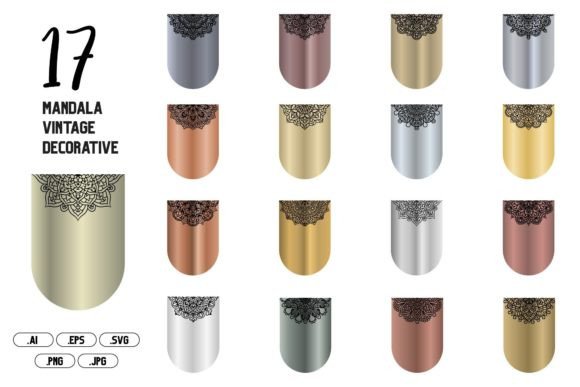
Mandala Vintage Decorative Graphics & Illustrations
First Impression: Warm, Handcrafted, and Timelessly Inviting
When I opened Mandala Vintage Decorative for a recent branding project with a local herbal tea shop—think small-batch blends, hand-poured tins, and apothecary-style labels—the first thing that struck me was its gentle balance of intricacy and calm. It doesn’t shout; it invites. The linework feels hand-drawn but precise, the symmetry grounded yet organic, and the vintage sensibility leans into warmth—not nostalgia for its own sake, but as an intentional cue toward craftsmanship and care. This isn’t bold or futuristic. It’s softly feminine, quietly elegant, and deeply aligned with brands rooted in wellness, handmade goods, botanicals, or artisanal food. Think: a candle brand launching a lavender-honey seasonal line, a boutique soap maker refreshing their holiday packaging, or a children’s book illustrator building a cohesive merch suite.
Where It Shines in Real Local Business Branding
Mandala Vintage Decorative works hardest where visual storytelling meets tactile experience—especially in packaging design and product label applications. On matte-finish kraft paper tea boxes, it becomes a subtle hero element at the top third of the front panel. As a foil-stamped accent on soy wax candle lids, it adds quiet luxury without overwhelming. For a local florist’s thank-you card suite, it anchors the corner beside handwritten calligraphy—elegant but never stiff. And for social media graphics? It scales beautifully into Instagram story banners, Pinterest-ready printable quote cards, and Facebook event announcements for pop-up markets.
It strengthens small business branding by delivering immediate visual cohesion: consistent decorative rhythm across hang tags, stickers, menu headers, and website banners tells customers, “This is thoughtfully made—and this is who we are.” That consistency builds recognition faster than any logo alone. In shelf environments—farmer’s market stalls, boutique retail displays, or local grocers—it lifts perceived value, helping handmade products stand out not through loudness, but through refined presence.
Practical Applications Across Touchpoints
- Product labels: Works best as a secondary brand element—framing ingredient lists or wrapping around jar necks (SVG or EPS ensures crisp vector scaling)
- Packaging accents: Ideal for die-cut windows, belly bands, or ribbon seals on gift boxes and seasonal bundles
- Social media graphics: Transparent PNG lets it layer cleanly over textured backgrounds in Canva templates or editorial design layouts
- Printable design: Perfect for boutique-branded thank-you cards, recipe inserts, or loyalty program welcome kits
- Product mockups: Drops seamlessly into realistic 3D packaging previews—especially effective on ceramic mugs, linen pouches, and apothecary jars
- Seasonal campaign visuals: Easily recolored to match autumn spice palettes or spring pastel launches without losing detail
Where to Use It Thoughtfully—Not Everywhere
While versatile, Mandala Vintage Decorative isn’t universal. It should be used carefully—or avoided—in contexts demanding high functional clarity. Don’t place it directly behind critical legal text on food labels, where transparency or contrast could compromise readability. Avoid cramming it onto crowded ingredient panels or tiny 1.5-inch sticker labels where fine linework blurs. It also sits uneasily beside ultra-minimalist or monochrome luxury branding—think black-on-black skincare or Scandinavian furniture lines—where its decorative nature competes with restraint. And while beautiful on warm-toned backgrounds, test it rigorously against low-contrast surfaces (e.g., light beige on cream) to ensure the SVG or transparent PNG maintains edge definition.
What a Brand Designer Actually Tests Before Finalizing
Before locking in Mandala Vintage Decorative for client work, I run these checks:
- Mockup realism: Print it at actual size on the intended substrate—kraft paper, recycled board, or metallic foil—to verify line weight and spacing hold up
- Black-and-white viability: Convert to grayscale and check if key details survive for blind embossing or single-color print runs
- Font pairing: Test beside serif (e.g., Playfair Display), sans serif (e.g., Montserrat), script (e.g., Pacifico), and display fonts (e.g., Cinzel) to confirm hierarchy stays intact
- Color integration: Overlay with the brand’s primary palette—does it harmonize or clash? Does the SVG allow easy recoloring without flattening layers?
- Licensing verification: Confirm commercial license covers physical product sales, digital marketing visuals, and client deliverables—not just personal use
- Transparency audit: Open the PNG in Photoshop and zoom to 400%—are edges clean? Is there unintended haloing or compression artifacts?
Why This Graphic Design Asset Fits Small Business Realities
For local business owners juggling production, inventory, and customer service, Mandala Vintage Decorative delivers professional-grade polish without requiring custom illustration budgets. Its multi-format delivery—AI, SVG, transparent PNG, JPG, EPS—means it adapts whether you’re editing in Illustrator, dragging into Canva, prepping for print vendors, or building Shopify banners. As a digital product, it accelerates turnaround. As a graphic design asset, it supports stronger visual hierarchy and more confident professional branding. Most importantly, it helps small teams communicate intentionality—not just “we sell soap,” but “we craft moments of stillness, one handmade bar at a time.” That emotional resonance, backed by smart execution, is what turns casual buyers into loyal advocates.